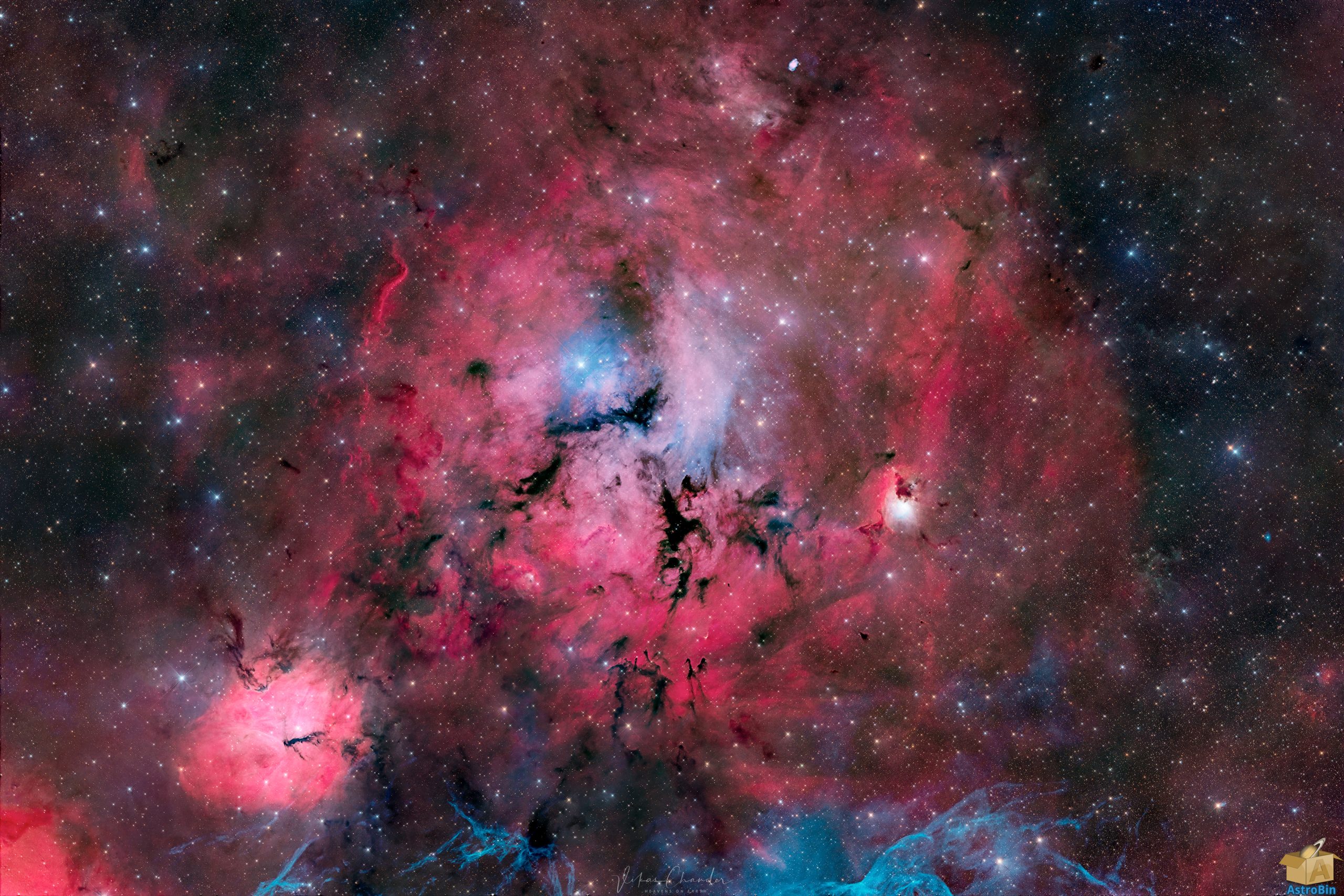
Deep in the southern constellation of Vela lies the sprawling emission complex of RCW 27, a rich tapestry of ionized hydrogen clouds, dark dust lanes, and delicate arcs sculpted by oxygen gases. Intricate filaments and crimson tendrils spread across a vast expanse of space, revealing the turbulent aftermath of massive star formation and stellar death.
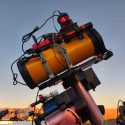
Captured from the pristine skies of Chile, on my Takahashi Epsilon-160ED astrograph, the resulting scene feels almost alive — glowing clouds drift through the frame like cosmic smoke while pockets of obscuring dust carve mysterious silhouettes against the luminous background. Embedded stars pierce through the nebula, their radiation energizing the surrounding hydrogen gas into its characteristic deep red glow. RCW 27 is not merely a nebula, but part of a gigantic interstellar ecosystem where stars are born, evolve, and ultimately reshape the galaxy around them.